Resources
Unlocking the Potential of Wind‑Solar Hybrid Systems
Published on December 2, 2025
In Europe, wind and PV generation profiles are typically complementary in their diurnal and seasonal patterns: Wind assets tend to produce more during winter and overnight hours, while PV peaks in summer and midday.
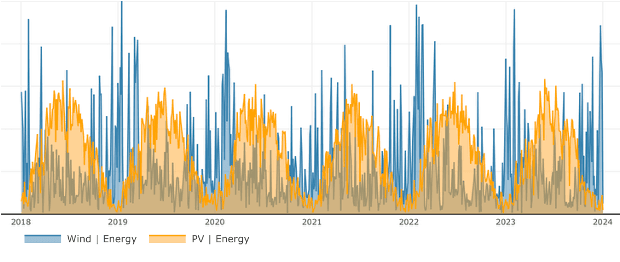
Co-locating wind and PV results in a more firm joint production profile with reduced intermittency and higher grid connection point utilization. Their complementary generation patterns limit curtailment losses, even with substantial overbuilding. From a PPA offtaker's perspective, a wind‑PV‑hybrid profile reduces the mismatch between production and energy needs and lowers exposure to market volatility.
Regional Hybridization Potential
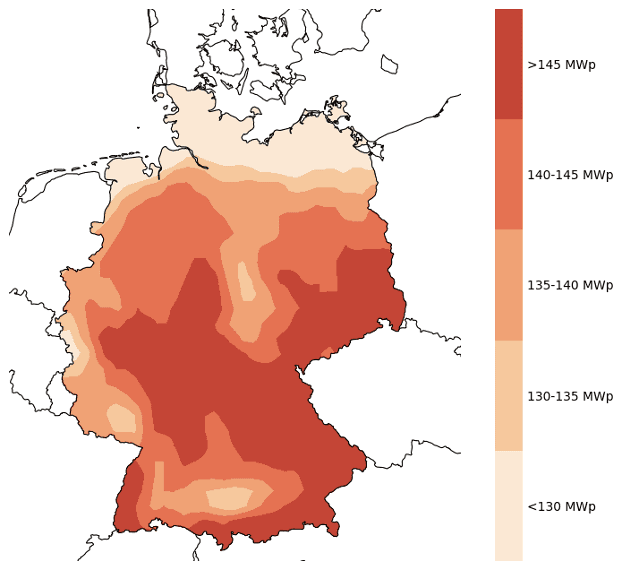
Hybridization potential refers to the amount of photovoltaic (PV) capacity that can be installed alongside a wind farm while keeping grid limitation losses within acceptable levels. In the example shown, a 100 MW wind asset is paired with varying PV capacities under the constraint that annual grid losses do not exceed 3% of total generation. Regional differences in solar irradiance and wind patterns mean that certain areas can support more PV capacity than others. Central and southern regions, for instance, demonstrate the highest potential, exceeding 145 MWp in some cases, due to favorable solar resources and complementary wind profiles. The map shows the amount of PV capacity that can be co-located with a 100 MW Wind asset, assuming a 100 MW grid connection point, sized to ensure grid limitation losses do not exceed 3% of annual generation.
More Power, Same Grid Connection...
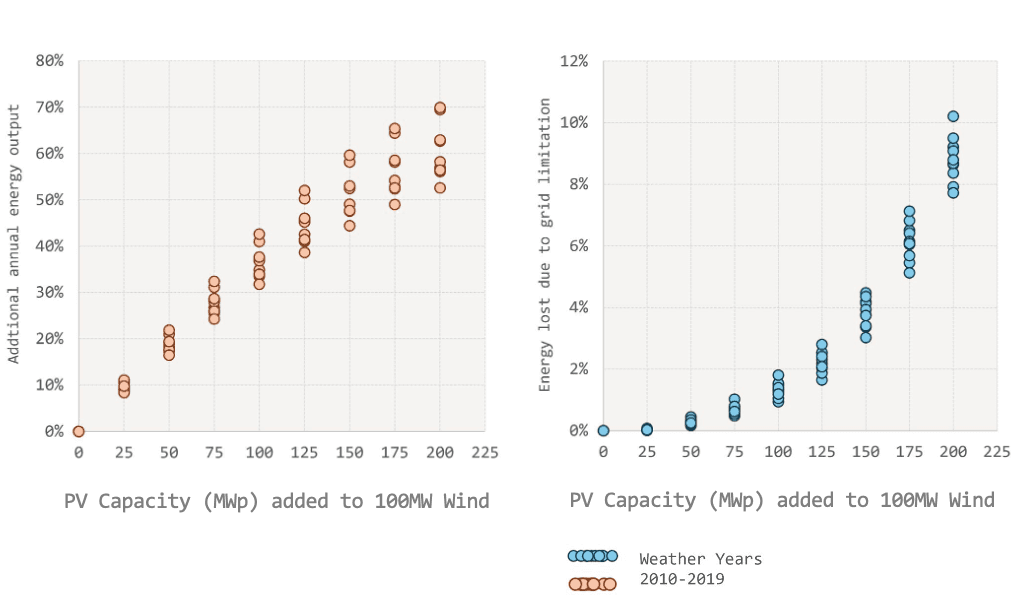
By adding PV to an existing wind farm, total annual energy output can increase significantly without requiring additional grid infrastructure. The balance between wind and solar generation helps smooth output over time, reducing peaks and troughs. However, accurate modeling is critical—multi-year, time-matched datasets should be used to capture real-world variability, as single-year or typical meteorological year (TMY) data can misrepresent the combined resource profile. Even with substantial PV additions—such as 150 MWp alongside 100 MW of wind—losses from grid limitations remain modest, often below 5%, provided high-resolution data is employed to assess curtailment accurately. Hybridizing a wind farm with PV can significantly increase total energy production, depending on PV sizing and site conditions. Modeling Insight: It's important to use multi‑year, matched wind‑solar datasets for simulation — considerable inter-annual variability in the combined resource can make single-year misleading, while TMY data should be avoided as it lacks time-matching between the resources.
...at Moderate Losses.
Even with 150 MWp PV added to a 100 MW wind farm, total grid limitation losses remain below 5% in many cases.
Modeling Insight: Hourly averaged data tends to underestimate actual curtailment losses. Where available, 15-minute or higher-resolution data should be used.
Reducing Price Risk for Offtakers
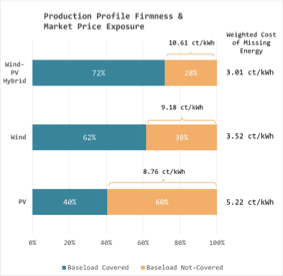
For energy buyers, particularly those entering into Power Purchase Agreements (PPAs), hybrid systems offer an additional advantage: a more stable and predictable supply profile. By covering a greater portion of the baseload demand, hybrids reduce exposure to periods when energy prices spike due to scarcity. In a German case study using forecasted 2024 day-ahead prices, wind‑PV hybrids covered 72% of the baseload at a lower weighted cost of missing energy (3.01 ct/kWh), outperforming standalone wind (62% coverage) and PV (40% coverage). This improved firmness translates to lower volatility risk and potentially more favorable contract terms for offtakers.
Conclusion
Wind‑solar hybridization presents a compelling opportunity to maximize renewable energy production, make better use of existing grid connections, and deliver more stable outputs to the market. By leveraging complementary generation patterns, developers can achieve higher capacity utilization with moderate curtailment losses, while buyers benefit from reduced exposure to price volatility. As high-resolution modeling and regional resource data become more accessible, hybrid projects are poised to play a central role in the next phase of renewable energy deployment.